


Choosing an inflatable tent for camping changes the work you do, not whether the tent needs work. Instead of joining and threading the main poles, you manage inflation, valves, and beam alignment. If you already use a pole tent, compare those changed routines with the parts of your current setup that you find difficult.
Table of Contents
Start with the problem you want to remove
Write down what slows your existing setup: sorting similar poles, reaching high sleeves, raising a heavy roof, or coordinating two people. An air system may address some of these, but it will not solve an undersized pitch, badly placed door, or too much luggage.
Compare an air tent with a pole tent that offers the same usable layout. Otherwise extra room can be mistaken for a benefit of inflation when it is really a benefit of buying a different size or shape. Keep the support choice separate from the floor-plan choice.
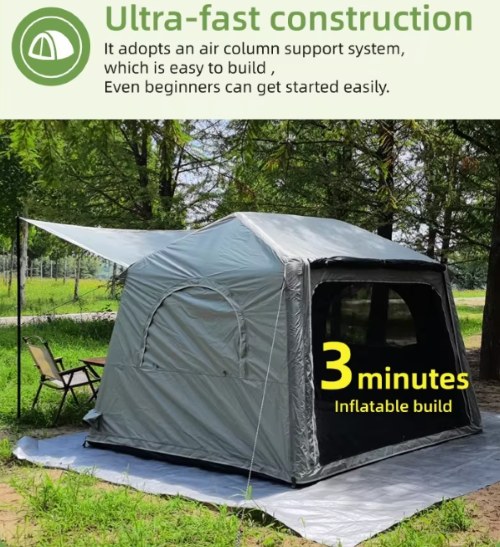
Replace pole assembly with a complete inflation routine
Read where the pump connects and how many inflation or isolation points must be operated. Check whether the fittings are reachable after the base is positioned, and whether the pump can be used comfortably without crossing the entrance or stepping on fabric.
Learn the specified pressure and gauge procedure before leaving home. Pressure is not simply a judgment of how firm a tube feels. The physical relationship between temperature and pressure is explained by NASA’s ideal-gas guide, but it does not supply a safe setting for any particular tent.
Use the tent pump guide to check equipment compatibility. A powerful pump that does not regulate or measure the required range is not automatically a convenient upgrade.
Rehearse the failure you could actually face
With a pole tent, you may already know which sleeve or spare section fits a damaged pole. An air tent needs a different plan: identify the affected chamber, distinguish its bladder from its outer sleeve, and locate the permitted repair access. Learn this from the manual with the system deflated, not by opening a pressurized beam.
Confirm whether the replacement parts are available for the model and whether the repair is intended for ordinary owners. If a structural fault occurs in unsuitable conditions, leaving for safer shelter is more important than proving that a repair can be completed on site.

Try the return journey before committing
Deflate and pack the tent using the full recommended sequence. Include the pump, hose, anchors, and repair materials in the load. Check the bag opening and handles, then carry the packed equipment over the kind of short route you expect to use, without exceeding what you can manage safely.
Think about drying at home. A larger tent can require a different drying space even if its pitching method is easier. The inflatable tent maintenance guide separates everyday care from pressure-system service.
Keep your pole tent if it remains the better fit for the intended journey. Air construction is a useful alternative when its particular routine suits you; it is not a universal replacement for every existing shelter.
FAQ
Will switching to air beams remove all poles?
Not necessarily. Some air tents retain separate porch, canopy, or auxiliary supports. Check the complete contents and instructions.
Can one adult pitch any air tent?
No. Shelter size, handling demands, conditions, and the manufacturer’s instructions determine the crew needed. Try the intended routine before relying on solo setup.
Do I need to learn pressure maintenance?
Yes. Know the prescribed checks, limits, and leak response for the model. Do not substitute a pressure value from another tent or pump.