

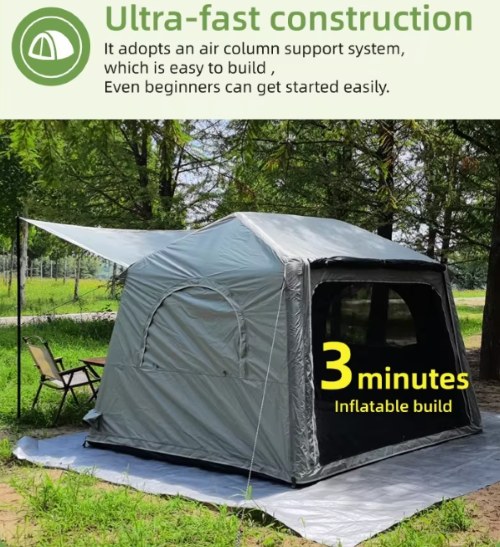
An inflatable tent pump must match both the tent’s valve and its specified operating pressure. A nozzle that appears to fit is not enough. Before inflating, find the pressure instructions for your exact tent and identify which adapter the manufacturer requires. There is no universal pressure setting for air tents.
Table of Contents
Start with the valve, not the pump's power
Compare the valve connection with the pump adapter: locking tabs, thread, sealing washer and insertion depth all matter. A loose fitting may leak during every stroke; an incompatible fitting may interfere with the valve mechanism. Do not force it, improvise a taped connection or assume an adapter from another inflatable is interchangeable.
Check whether the valve must be placed in an inflation position before attaching the hose. Follow the tent diagram rather than guessing from how the center pin looks. Keep dirt out of the opening and retain the protective cap where it will not disappear into the grass.

Manual and electric pumps solve different problems
A manual pump avoids dependence on batteries or a vehicle socket. Its practical disadvantages are physical effort and the space needed to move the handle. An electric pump reduces that effort, but its pressure range, adapter and power supply still need to suit the tent. High airflow alone does not establish suitability.
If an electric model has automatic shutoff, confirm that it can stop at the tent’s stated pressure and use it as its instructions describe. Do not connect a workshop compressor unless the tent manufacturer explicitly permits that equipment. For the broader pitching sequence, see the guide to setting up an inflatable tent alone.
Inflate with the gauge in view
Unfold the tent fully and arrange its beams without twists before adding air. Follow the specified anchoring and inflation order. Support the hose so it does not pull sideways on the valve, and watch the gauge as pressure increases. Stop at the documented target rather than pumping until the beam feels exceptionally hard.
Make sure you are reading the correct scale: PSI and bar are different units. A gauge’s behavior can also depend on its design and whether air is moving, so consult the pump instructions about when to take a reading. If the reading is implausible, stop and investigate before adding more air.
Trace the symptom before replacing anything
Stop inflating when operation becomes abnormal. Use the symptom to choose a check, not to diagnose a failed component without inspection.
| What happens | Check next |
|---|---|
| Inflation is unexpectedly slow | Hose kinks, loose fittings, pump mode and open deflation valves |
| Air escapes during disconnection | Valve position and the model's closure sequence |
| The handle resists but the beam stays soft | A blocked or incompatible connection; do not force the pump |

Compare pressure under similar conditions
A softer beam after a cold night does not prove a puncture. NASA’s explanation of gas pressure and temperature describes the underlying relationship. Temperature changes can affect readings, but persistent loss under similar conditions deserves inspection; use the inflatable tent maintenance guide for the next checks.
Pack the small parts deliberately
Let the pump and hose dry, remove surface grit and store the adapter with the pump. Avoid crushing the hose under a packed tent. Before the next trip, reconnect everything at home and confirm that the gauge, hose seal and power source work. A backup is only useful if its connector fits.
FAQ
Can I use an air-mattress pump?
Only if its fitting and operating range are explicitly compatible with the tent. Many mattress pumps are intended for a different pressure range.
What pressure should I use?
Use the value stated for your exact tent model. Neither tent size nor a generic online recommendation establishes a safe setting.
Should I keep topping up a soft beam?
Measure and investigate first. Repeated inflation can hide a valve problem or leak, and pressure may change again as conditions warm.