

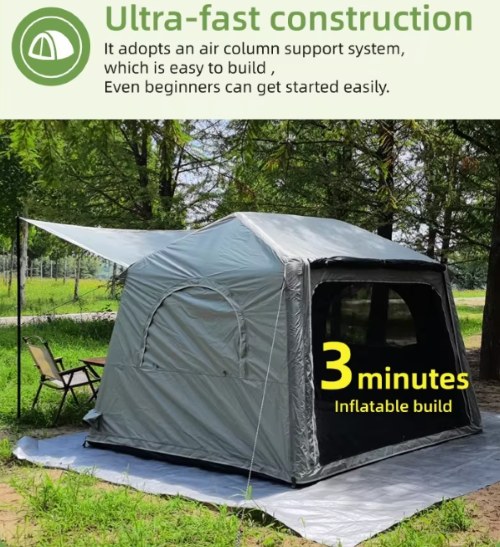
Tent guy line setup is complete when the tent has its intended shape, the anchors hold, and the doors still work normally. Tightening every cord as hard as possible is not the goal. Follow the model’s pitching sequence and use the lines required for that configuration, even if the tent can stand before they are attached.
Identify the intended load path
Check the pitching diagram for reinforced guy points and any internal fly-to-frame connections. A guy point needs to transfer load through the parts designed for it. Do not substitute a mesh loop, zipper pull, or spare-looking piece of trim.
Unwind cords before raising the shelter so knots and tangles do not interrupt anchoring. Check adjusters for cracks and confirm that replacement cord fits the device. A tensioner that slips on an unsuitable cord cannot hold an adjustment simply because the cord itself is strong.

Place anchors before fine-tuning tension
Run each line in the direction shown by the tent maker, with enough distance for the intended angle. Avoid turning the cord around a sharp edge or routing it across another line. If an obstacle makes the planned layout impossible, reconsider the pitch rather than pulling the panel sideways.
Use anchors appropriate for the surface and allowed by the campsite. Firm soil, loose sand, and a timber platform require different solutions. Our sand stake guide addresses loose-ground anchoring; a standard grass-pitch stake should not be assumed to work equally well there.
Adjust around the shelter in small steps
Begin from the tent’s correct basic pitch. Take up slack, then work around the shelter rather than fully tightening one side first. Watch the panel shape, floor corners, and frame or air beams as each adjustment is made. The Scouts’ tent-care guidance recommends even guy-line tension and cautions that overtightening strains tent material and poles.
Stop tightening if a door becomes difficult to close, an air beam is pulled out of alignment, or the floor lifts unnecessarily. Recheck the base pitch and neighboring lines. The final result should resemble the manufacturer’s intended geometry, not a tent stretched to occupy every centimeter of the site.
Read the result with doors and vents in use
Open and close entrances after tensioning. Check that the fly is positioned as instructed and that ventilation openings remain usable. Retain the designed gap between layers where the tent has one; lines should not pull the fly tightly against the inner shelter.
Walk the route someone will use after dark. Move the pitch or permitted anchor positions if cords cross a necessary walkway. Reflective cord helps visibility when illuminated, but it does not eliminate a badly placed trip hazard. Good campground tent placement makes this easier from the start.
Recheck without treating cords as storm protection
Look again after the fabric has settled, after rain, and when wind or ground conditions change. A line that is still tight does not prove its anchor is secure; inspect the anchor for movement too. Reset a loosening anchor according to its instructions before relying on it.
Extra guy lines do not make a camping tent a severe-weather refuge. National Weather Service camping advice explicitly says tents are not lightning-safe and recommends a sturdy building or enclosed hard-topped vehicle. Know your departure route before a storm develops.
At pack-up, remove anchors deliberately and gather each cord without cutting it. Coil or bundle lines so they cannot wrap around sharp stakes during transport, then replace damaged cords before the next trip.
Match tent guy line setup to the supplied configuration
Pianran’s Custom 7P Double-Door Inflatable Tent describes stakes, guylines and anchoring accessories alongside its porch layout. Confirm the actual supplied set and pitching diagram for the order. A kit count alone does not show which reinforced attachment each line serves or which ground conditions the anchors address.
For distributor instructions, identify the base anchors and the additional lines required by the selected configuration. Keep replacements matched to their tensioners and attachment method. Do not transfer a line layout from another tent simply because both shelters have the same advertised occupancy.

Use visible changes to guide the next adjustment
When the tent shape changes during tensioning, pause and identify which adjustment caused it. Work from the documented basic pitch rather than trying to correct every distorted panel by pulling another cord harder. Check the anchor as well as the line.
Use the table to distinguish geometry, connection and ground-holding problems. These checks help explain setup; they do not measure wind resistance or replace the manufacturer’s operating limits.
| Observation | Likely check area | Next step |
|---|---|---|
| Door becomes distorted | Basic pitch and uneven line tension | Restore documented geometry |
| Line slips through adjuster | Cord and tensioner compatibility | Use the specified matched components |
| Anchor rises or rotates | Ground engagement | Reset using the approved system |
| Cord crosses a route | Pitch layout | Relocate within permitted positions |
Prepare a setup handover that crews can repeat
For rental crews or retail demonstrations, provide a model-specific drawing with the line routes and intended attachment points. Show the completed shelter with doors and vents operating normally, and keep walking routes visible in the drawing.
Ask a second reviewer to follow the instructions on an appropriate practice pitch. Record any ambiguous connection before finalizing the handover. If the site cannot accommodate the required lines, change the layout or shelter selection. Send the tent reference, anchoring surface and available pitch outline to discuss the supplied equipment and the correct setup information.
Conclusion
Start with the correct pitch, then balance the required lines while checking anchors, doors and vents. Clear instructions should identify the whole connection path and help users recognize when further tightening is the wrong response.
FAQ
How tight should a guy line feel?
There is no universal hand-tension target. Remove slack and achieve the documented tent shape without distorting doors, panels, or the supporting structure.
Do freestanding tents still need guy lines?
Follow the tent instructions. Standing without support does not establish the completed pitch or its performance in wind and rain.
Can I attach a line to a tree?
Only when the land manager permits it and the attachment is appropriate for the tent and tree. Do not damage bark or stretch cords across shared routes.
Is the number of supplied cords enough to explain the setup?
No. Users also need the model-specific attachment locations, line routes and anchor requirements. Identify which configuration the instructions cover.
Can I replace a cord with one of the same apparent thickness?
Confirm compatibility with the tensioner and connection method. Similar diameter alone does not establish that the adjuster will hold the replacement correctly.