

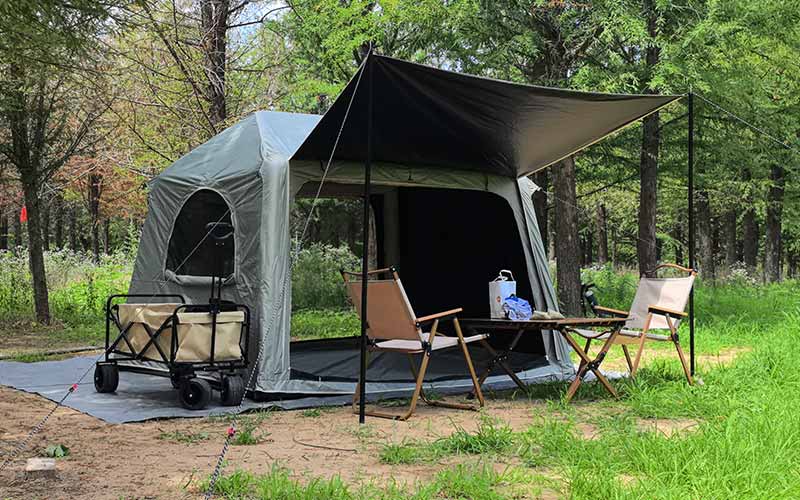
OEM inflatable camping tents can range from an existing model with a different logo to a substantially redesigned shelter. Those are not equivalent projects. Define what will change before discussing production: graphics, room arrangement, fabric construction, and the air system each have different consequences for development and support.
Table of Contents
Separate decoration from a new shelter design
A printed logo may leave the physical structure unchanged, while moving a door can affect panels, seams, access, and the surrounding frame arrangement. A larger bedroom can require more than extending a floor pattern. Describe each requested change and what existing components you expect to retain.
Mark the changes on a drawing of the proposed model rather than combining features from unrelated photographs. The custom versus standard tent comparison helps decide when an existing layout already solves the intended need.
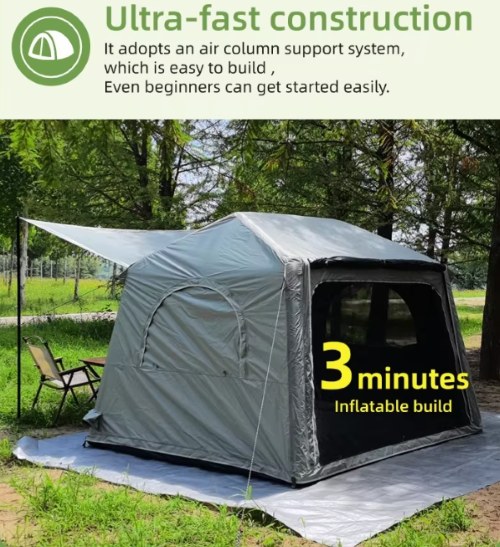
Resolve the air system before accessories
Decide whether chambers inflate separately or through a connected system, and establish how the intended design handles isolation and replacement. Record the valve and pump interface, pressure instructions, and access needed to service a chamber. Do not allow a change of pump to become an undocumented production convenience.
Ask what happens when one chamber loses air and which parts a customer can replace without specialist equipment. Keep those answers specific to the final design. The inflatable tent air-beam guide provides a focused companion for these structural decisions.
Specify fabric construction without category mistakes
Keep fiber, weave, coating, and assembled-panel details in separate fields. Oxford is a weave description, not a competing fiber to polyester; a polyester fabric may use an Oxford construction. CottonWorks’ weaving reference identifies Oxford as a basket-weave variation.
Define what a material change is intended to achieve and how that outcome will be evaluated. A heavier fabric or different coating should not be accepted as automatic proof of greater waterproofness, lower condensation, or longer life. Those are separate performance questions.

Tie testing to the production configuration
Identify the final model and revision before commissioning relevant testing. ISO 5912 sets out camping-tent requirements and test methods; its public scope covers safety, performance, and fitness for use. Decide the applicable test program with a qualified laboratory rather than assigning claims from a standard’s title.
If a door, seam arrangement, fabric, or air component changes afterward, ask the laboratory which conclusions remain valid and which need reassessment. Retain report scope and configuration records. A report on an earlier version is not a blank approval for every later variant.
Plan the repair path before the first shipment
Give valves, replacement bladders, and other service parts stable identifiers. State which model revisions each part fits and how long supply is agreed to continue. Where a repair needs professional work, make that limit clear rather than providing an unsuitable universal patch kit.
Write instructions from the final construction, including the actual inflation sequence and pressure information. Confirm who handles technical questions and how a returned unit is matched to its revision. This prevents a private-label project from reaching customers with accurate graphics but instructions for a different tent.
FAQ
Does OEM always mean a completely new tent?
No. The term is used for different arrangements. The agreement should state whether the project changes branding, modifies an existing model, or develops a new structure.
Can one replacement bladder serve several sizes?
Only when compatibility is established for those models. Shape, dimensions, connections, and sleeve fit matter; similar names are not sufficient.
Should graphics be finalized before the door layout?
Set the physical panel and opening layout first. Otherwise artwork may land across a zipper, vent, fold, or attachment that later moves.