


The inflatable tent vs traditional tent choice changes the equipment you carry and the maintenance tasks you perform. Compare complete packages, repair options, storage requirements, and the conditions each model is intended to handle. Here, traditional means a camping tent supported by poles, which may be flexible or rigid.
Tabla de contenidos
Compare the space it occupies at home
Measure where the tent will live between trips and how you will move it from there to the vehicle. Include pumps, pole bags, and accessories. A shorter bundle can still be harder to handle if it is wider or concentrates more weight in one bag.
Consider drying space as part of ownership. Can you spread or hang the fabric without damaging it, and can you reach hidden damp folds? Both frame types still have a textile shelter to care for. The tent storage bag guide distinguishes the travel package from the conditions needed at home.
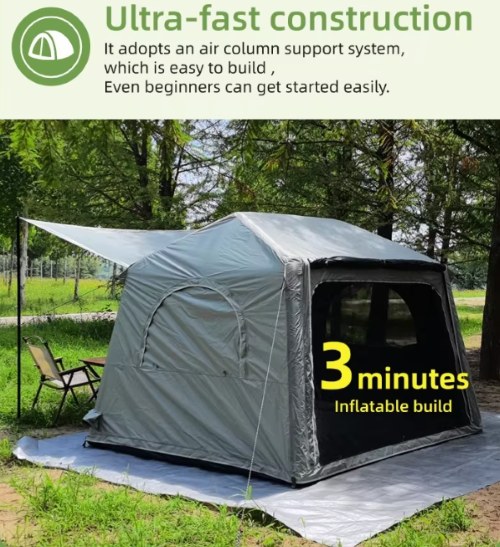
Know what your packing routine must preserve
A pole tent needs all the correct sections, connectors, and separate pieces kept together. An air tent needs its compatible inflation equipment and intact air-system components. Neither is necessarily the smaller or lighter package; compare models with similar usable space.
This table describes ownership tasks, not performance rankings.
| Task | Air-beam tent | Pole-supported tent |
|---|---|---|
| Pre-trip preparation | Check valve operation and the correct pump and adapters | Check pole sections, joints, and attachments |
| Dividing the load | Determine which accessories and body parts can travel separately | Determine whether poles, fly, and inner can be separated |
| Returning from rain | Dry fabric and protect air-system components during packing | Dry fabric and keep hard components from damaging it |
| Replacement planning | Match valves or bladders to the precise model revision | Match pole geometry, diameter, joints, and attachment ends |
Find the repair route before it becomes urgent
Look for identifiable replacement components and clear instructions on who can fit them. A retailer having a patch kit does not prove it can replace a damaged valve assembly. Equally, a generic tent pole may not match the bends and attachment points of a particular shelter.
Ask whether discontinued models retain service support and how model revisions are identified. Keep the manual and part references with your camping records. The repair kit guide helps separate temporary fabric repairs from the structural parts needed to restore a tent.

Choose the routine you can maintain
If you dislike organizing long pole sections, an air system may remove that irritation. If a single bulky body is difficult to lift, a model with separable components may be preferable. Neither preference implies that the other frame is obsolete or unsuitable for regular travel.
El Camping and Caravanning Club’s component reference shows the variety of pole and air-tube arrangements. Inspect the actual design, and use its instructions for disassembly or deflation. Do not assume an electric pump’s suction mode is approved for every bladder.
For occasional use, make pre-trip inspection easy rather than leaving the bag unopened until departure. For frequent trips, prioritize replacement access and a drying routine you can repeat. The best ownership choice is the tent you can keep ready without bypassing necessary checks.
Preguntas frecuentes
Will an inflatable tent last longer than a pole tent?
Frame type alone cannot establish service life. Use, exposure, fabric condition, component availability, and care all matter for a specific model.
Is a traditional tent always harder to transport?
No. Some pole tents divide into manageable packages, while others are bulky. Compare complete packed dimensions and your actual carrying route.
Can both types be stored in a garage?
Only if the storage conditions suit their care instructions. Dampness, excessive heat, pests, and sharp equipment can make a convenient garage location unsuitable.