

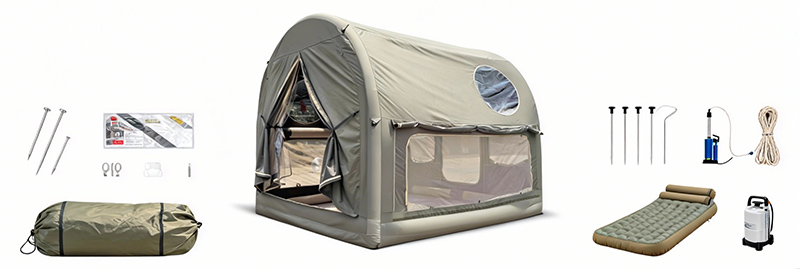
An inflatable tent manufacturer needs more than an attractive first sample to support a repeat-order program. For outdoor brands and distributors, the practical question is whether the next batch will match the agreed tent, instructions, accessories, and replacement parts. Establish a recorded reference configuration, require notice of relevant changes, and connect each delivery to its production version before releasing it to customers.
Tabla de contenidos
Give the repeat order an exact reference
Keep a dated model specification with the approved floor plan, air-system arrangement, material descriptions, included kit, labels, and instruction version. Photographs help identify the configuration, but should accompany dimensions and part identifiers rather than replace them. Retain the reference sample where practical, with its approval status and any accepted exceptions recorded.
Within an gama de tiendas inflables, a similar outer shape can hide a different doorway, chamber arrangement, or accessory package. Place the agreed identifier on the order and inspection documents. When reordering, confirm the current revision instead of asking for the same tent as last time.

Separate appearance changes from compatibility changes
Define which substitutions require review before production. A valve change can affect adapters, instructions, and the parts already held by your service team. A new fly material may require different evidence or care instructions. An explanation that the replacement is equivalent is a starting point for review, not a record of what changed.
For illustration, suppose a replacement pump connects to the valve but has a different gauge or operating method. Physical connection alone does not establish suitability. The tent’s permitted inflation procedure, pump specification, and user instructions need to remain consistent. Treat unresolved compatibility as a reason to pause the affected configuration.
| Proposed change | What the buyer needs to resolve |
|---|---|
| Valve or air-chamber revision | Pump compatibility, part identification, instructions, and repair access |
| Fly, floor, or coating substitution | Material identity, relevant evidence, joining method, and care requirements |
| Door or window arrangement | Usable layout, attachments, operating instructions, and evidence applicability |
| Accessory-package change | Updated kit list, labeling, and what existing customers will receive |
Ask your inflatable tent manufacturer for batch records
Discuss checks with the inflatable tent manufacturer before the batch starts. Identify the inspection stage, method, agreed acceptance criteria, and record retained for relevant materials, air-system integrity, assembly, and packed contents. Do not invent a universal inflation pressure, hold time, or sampling percentage; these need an appropriate technical basis for the model and order.
The useful record connects a result to an identifiable item or batch and the specification used. A collection of undated inspection photographs cannot tell you which shipment was checked. Agree how the buyer or appointed inspector can review the relevant records, including how exceptions and corrective work are recorded.
Keep the scope of any certification clear. ISO 9001 concerns quality management systems; it does not replace evidence for a particular tent’s performance. A company document and a product test report answer different questions.

Keep performance evidence tied to the supplied tent
For each claimed performance, identify the report, tested material or model, configuration, method, and limitations. ISO 5912 is a requirements and test-method reference for camping tents. Citing it does not establish that a particular product complies, and a camping-tent reference should not be assumed to cover a public event structure.
Ask the responsible technical assessor whether a proposed production change affects the relevance of previous evidence. For a new layout or air system, use the separate OEM tent design-change article to distinguish repeat production from development work. Resolve destination-specific requirements with qualified support rather than treating one document as universal clearance.
Make a discrepancy traceable to the affected units
Agree how cartons, products, and spare parts identify their model and production version. The appropriate identifier depends on the product; it must let both teams distinguish affected units from unaffected stock. Keep the component list and manual with the order records so a later service question can be answered against the correct configuration.
If a delivery differs, record the order, carton or batch reference, photographs, and the precise discrepancy. Separate affected stock while the supplier investigates and confirm the resolution before release. Avoid distributing an uncertain revision and expecting customers to discover whether an adapter or replacement beam fits.
For a Pianran repeat-order discussion, send the model reference and intended order details, including destination market, planned quantity, current configuration, and any requested changes. Identify the unresolved technical point so the next conversation can address it directly; availability and supporting documentation still need confirmation.
Preguntas frecuentes
Does a matching model name guarantee identical construction?
No. Ask which revision will be supplied and whether materials, components, instructions, or included accessories have changed since the previous order.
Does an approved sample replace production checks?
No. It provides a reference configuration. The inspection plan and retained records address whether production follows that reference.
What should change when a spare part is revised?
Record the new identifier, the tent versions it fits, and any changed installation instructions. Do not assume a visually similar part is interchangeable.