

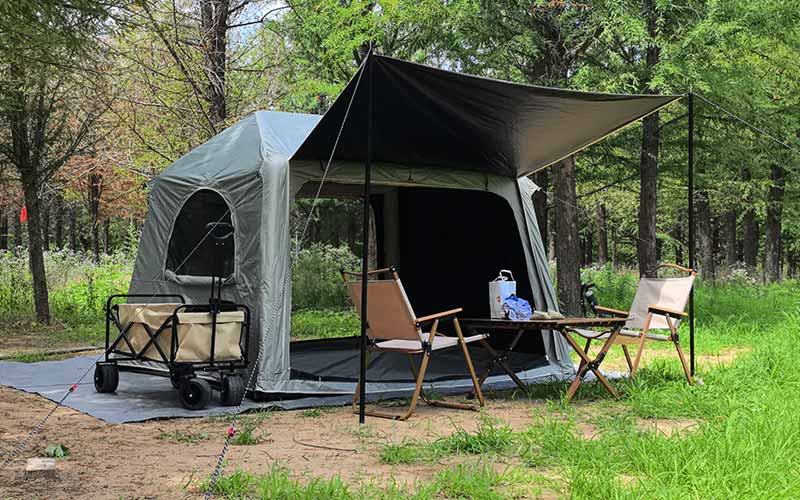
Custom inflatable tents can involve anything from a different printed panel to a new floor plan and air-beam arrangement. Those are not equivalent projects. Define the problem a standard tent cannot solve, then change only the parts necessary to address it. A larger beam or heavier fabric is not automatically a better design.
Table of Contents
Begin with the constraint a standard tent misses
Draw the required occupied layout: beds or displays, doorways, working positions and clear routes. Add the available pitch and transport dimensions. A request for ‘more space’ becomes useful when it identifies the doorway that needs to move or the bed that cannot fit under a sloping wall.
Decide whether the change is essential or whether a different standard size solves the problem. The custom versus standard tent comparison helps separate a genuine layout requirement from preferences that can be addressed with removable equipment.
Separate surface changes from structural decisions
Printed graphics, removable room dividers and repositioned entrances have different consequences. Graphics require an appropriate print layout; a moved entrance changes the panel construction and how people use the interior. A changed beam layout or attachment geometry requires competent structural evaluation rather than a cosmetic approval.
Use a change record that identifies what is altered and what depends on it. For example, a wider doorway may affect the fly overlap, inner door, nearby attachment points and packing instructions. Review those connections together so the new opening is not treated as an isolated rectangle in the drawing.
Specify materials without shortcuts
Describe the relevant layer and function: outer textile, coating, airtight bladder, protective sleeve or groundsheet. ‘TPU tent’ does not explain which component contains TPU, just as ‘waterproof fabric’ does not describe a seam. Require enough detail to connect the construction to cleaning and repair instructions.
Avoid treating a fabric test as evidence for every aspect of the shelter. ISO 811 addresses textile resistance to water penetration under hydrostatic pressure. A changed floor joint or door cover needs its own appropriate evaluation, not merely the original cloth rating printed beside it.

Choose the evaluation around the intended use
A camping shelter and an occupied event structure can involve different requirements. ISO 5912 covers camping-tent safety, performance and fitness for use; do not assume its scope establishes approval for every commercial installation. Define applicable requirements with the relevant technical specialist and venue or local authority where needed.
Record which final configuration is being evaluated, including sidewalls, anchors and accessories. Do not publish universal wind, capacity or waterproofness claims based on appearance. The design should have documented operating limits and an understandable response when those limits may be exceeded.
Keep custom parts serviceable
Ask how the altered tent will be identified during a repair and which parts differ from the standard version. A unique bladder shape or relocated valve can affect spare-part compatibility. Keep dimensions, connection details and model revisions with the maintenance documentation.
For an event tent, retain its approved panel map and installation arrangement along with the physical design record. The exhibition inflatable tent design guide addresses placing readable graphics around curved surfaces. Resolve those details without turning the tent’s air beams into unapproved supports for signs or equipment.
FAQ
Does a custom tent have to use a new frame design?
No. Some projects need only approved artwork or a compatible removable component. Structural redesign should answer a specific unmet need.
Will thicker beams guarantee better wind performance?
No. Performance depends on the complete structure, connections, anchoring and configuration, supported by appropriate evaluation.
Can a custom color use the standard test report?
Ask the responsible specialist whether the change affects the report’s applicability. Do not assume all material or printing changes are immaterial.